
The sun is glinting on the sea beyond my window, past the rooftops, past the cedar and the distant gum that marks the horizon.
Crested pigeons have ousted the tawny frogmouths in the magnolia at my north window. Lorikeets chatter, eagles ride unseen currents and white cockatoos trail across the sky before claiming the treetops.
The studio is quiet.
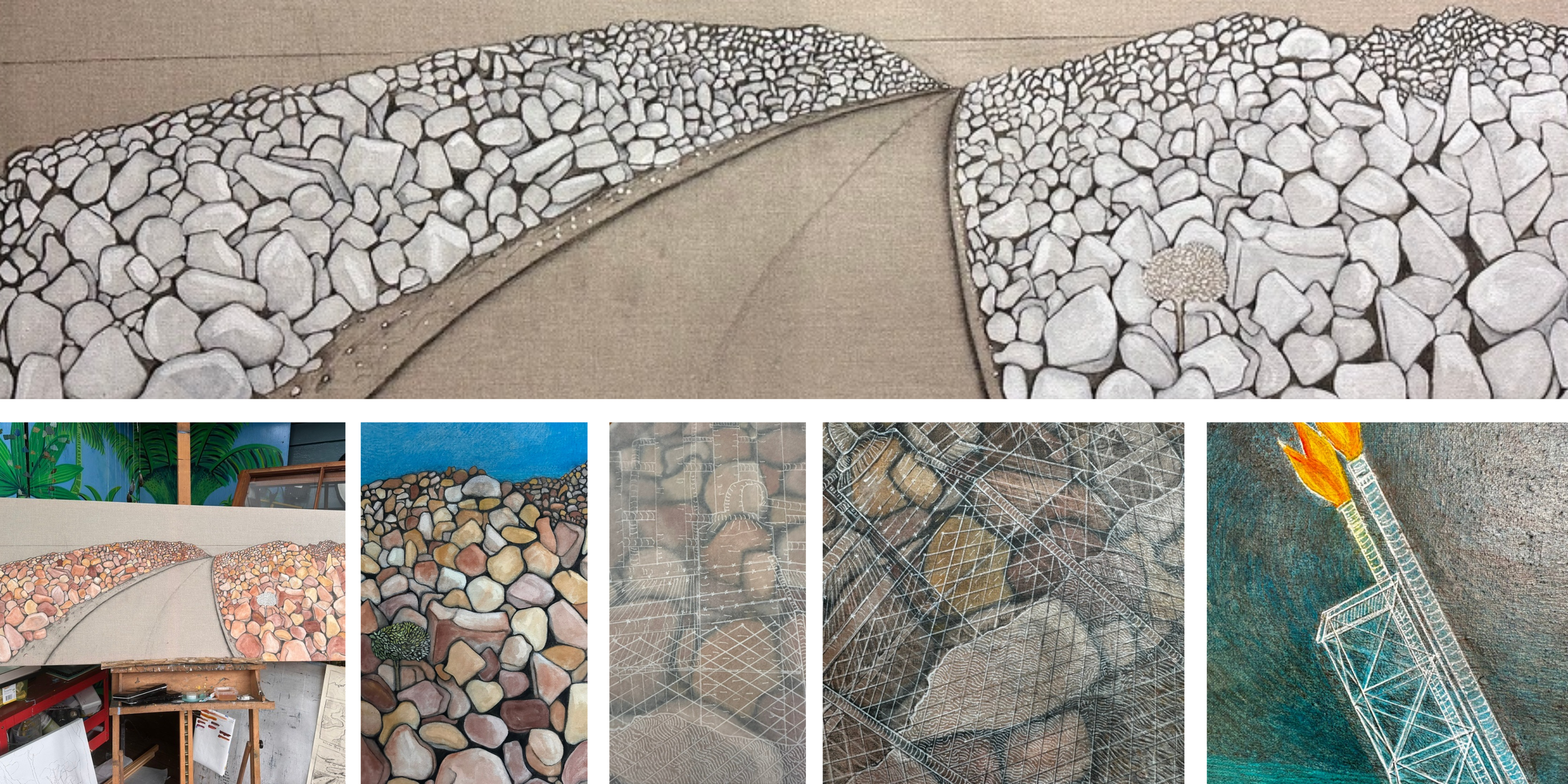
On the easel, the Burrup Peninsula work progresses as part of my Tracing Australia series.
Layer by layer it comes together.
Belgian linen, painted with clear gesso to reveal the natural tone of the support material.
Charcoal to sketch up the scene.
Watercolour ground applied where earth pigments, graphite and watercolour, will be used.
I paint in rocks, road, sea and sky.
I lay a sheet of thin archival tracing paper over the work and draw the outlines of fences, barbed wire, chimneys, tanks and endless pipes that now stretch across the left side of the canvas overlaid over rocks, sea and sky.
I carefully glue this in place, then add shadows with graphite.
The sky darkens.
One of the most significant encounters on our trip around Australia was in Dampier, on the Burrup Peninsula the site of the Murujuga Cultural Landscape.
We had left the boab trees of the Kimberley behind us and ventured into the red earth of the Pilbara. Entering Dampier we arrive in a landscape where industry is impossible to ignore. We stayed in the only camping spot in the town with a view to the port and the constant movement of ore carriers and LPG tankers.
Driving from our campsite, we passed massive construction sites, new and expanded ports, more processing plants, but also boulders that cover the whole of the peninsula. Finally we come to the entrance to Nganjarli (Deep Gorge), where we appropriately access the rock art site. Appreciative of Ngarda-Ngarli Traditional Owners and Custodians[1], whose continuing cultural relationship with Murujuga is central to its World Heritage recognition.
On one side of the road there are huge red rocks piled high and stretching as far as the eye can see. As you walk among them you spot engravings of animals, birds, fish, weapons and symbols I don’t understand. It is apparent that this was an important place. The scale is monumental and the colour of the site against the cobalt sky and turquoise sea is breathtaking.
It is estimated there are one to two million engravings that were created over approximately 50,000 years[2], their stories continuing across generations. Some of these are older than the pyramids or the Lascaux cave paintings. The rocky mountain ranges transformed as sea levels rose after the last ice age, to become the archipelago we see today.
I sit with the reverberations of this fact. Trying to take in what I am seeing.
I think about what I learnt at school and the significance that was given to prehistoric art, how I marvelled at it, how it became places I always wanted to visit, sites that were used as examples of the evolution of man, art making and storytelling.
Never once was Murujuga mentioned.
On the other side of the road, the rocky landscape gives way to an expanse of industry. [3]Yara Pilbara's ammonia plant, [4]Perdaman's massive new fertiliser plant under construction, and beyond them, [5]Woodside Energy's gas-processing facilities.
silver chimneys thrust against the sky
perpetual flames interrupting an unending blue.
miles of pipes
fences
industry
The juxtaposition is staggering.
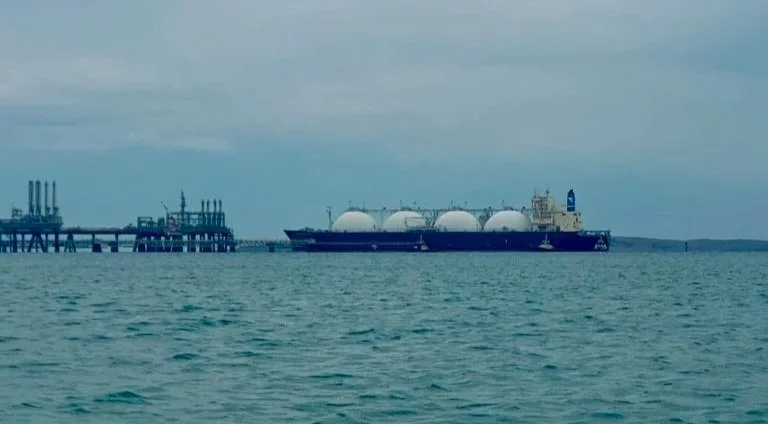
Gas tankers Burrup, Withnell Bay
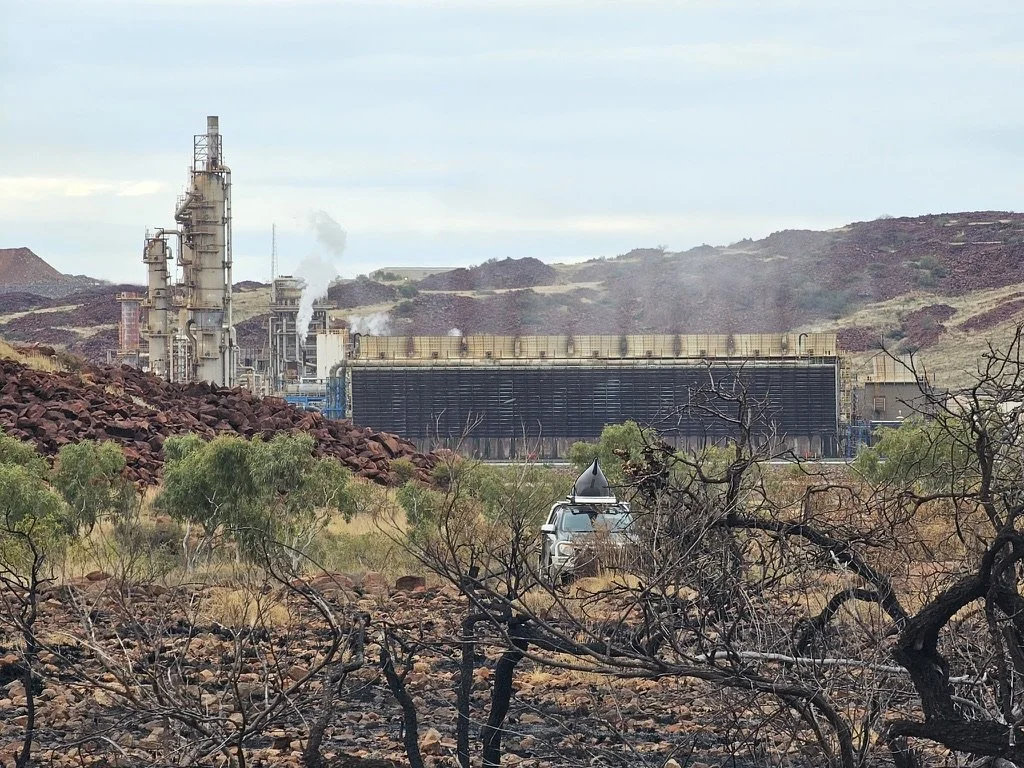
View from Murujuga National Park towards processing plant
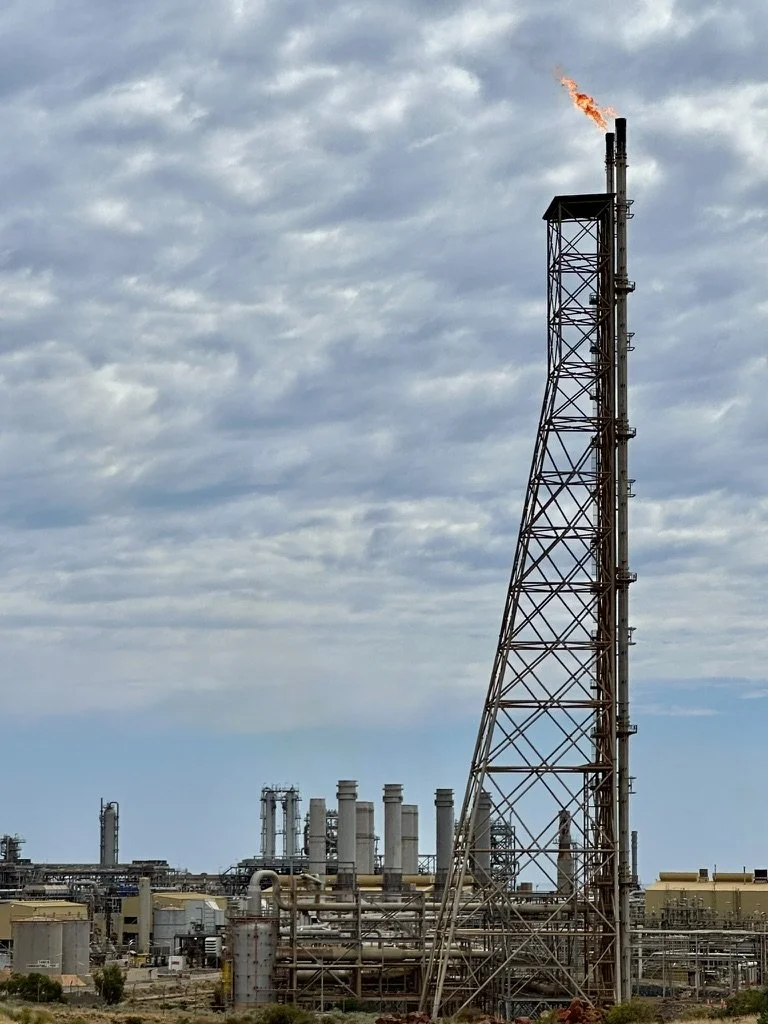
view from Withnell Bay access road
The Burrup Peninsula is just one rare, extraordinary place we have seen on our journey but it poses provocative questions.
Can and should large-scale industrial developments sit alongside sensitive cultural sites?
What will we have obliterated, and what will be protected and held as significant to future generations?
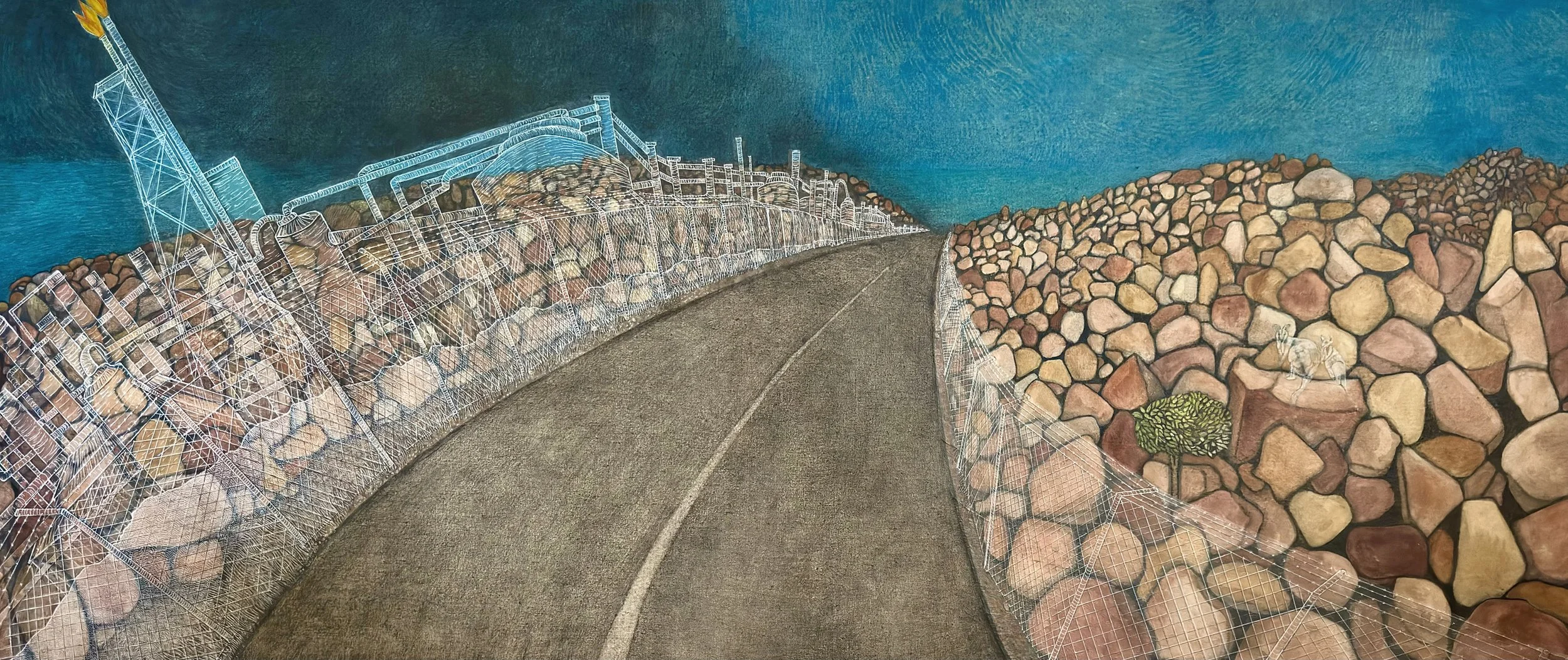
The Road to Murujuga
These ideas and questions rumble around in my brain.
Tracing Australia is more than a series of landscapes or postcards. Through these works I am trying to understand our relationship with this continent, our responsibility to it, the stories that shape it. Do these stories become part of our identity and whose stories are we telling, or can we tell?
Twelve months later I am in Sydney visiting [6]Sidney Nolan’s Origins exhibition where I experience the Ned Kelly paintings that shifted perceptions of Australia and reached audiences well beyond our shores. This is country I have seen and known.
We had listened to [7]Tim Winton’s Juice as we drove through the Pilbara and in a similar way to Nolan’s use of a visual language, through literature, Winton creates a landscape shaped by climate catastrophe. Both are rooted in this place, yet speak to concerns that reach far beyond it.
Can my own encounter with Murujuga, translated into an artwork, do the same?
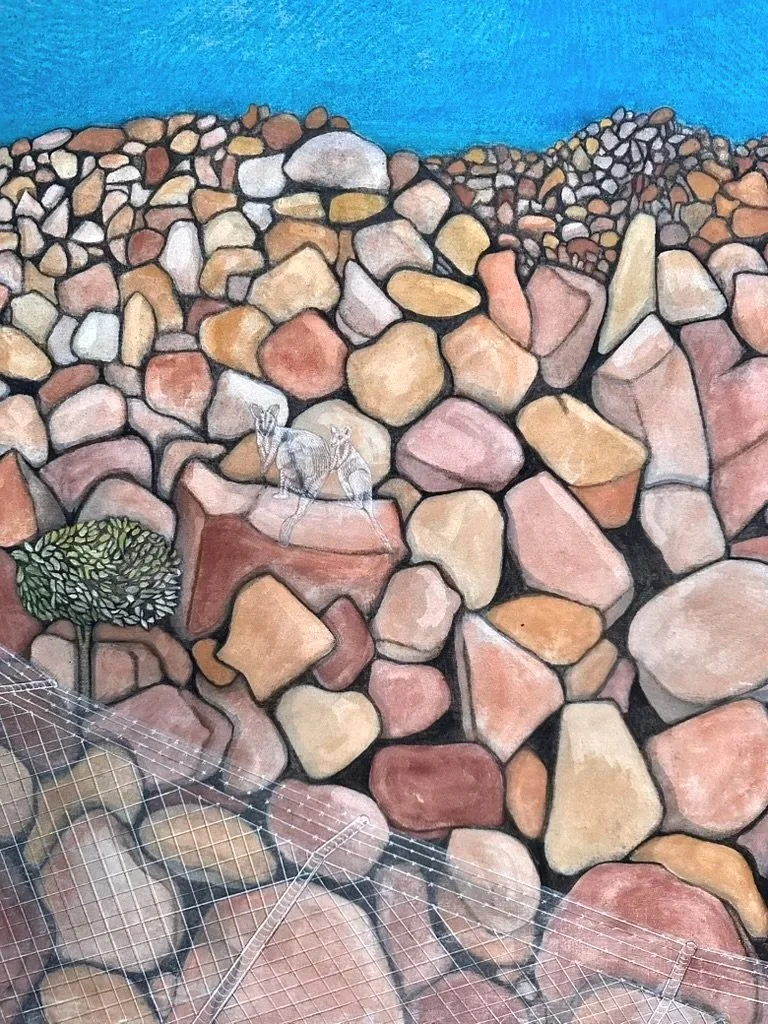
Back at the easel,
something is missing,
a witness to what was and what will be.
The story behind the engravings is not mine to tell.
While this experience is layered, I can only paint how this site affected me and what I understand from my own perspective.
We walk with a sense of reverence and awe among the rocks, spotting engravings of emu, wallaby, fish, goanna, carved into the stone.
A small tree grows persistently between boulders.
High on the mound of rocks a wallaby watches.
Acknowledgment
I acknowledge the Ngarda-Ngarli Traditional Owners and Custodians of Murujuga and their continuing connection to and care for this extraordinary cultural landscape.