
the studio in waiting
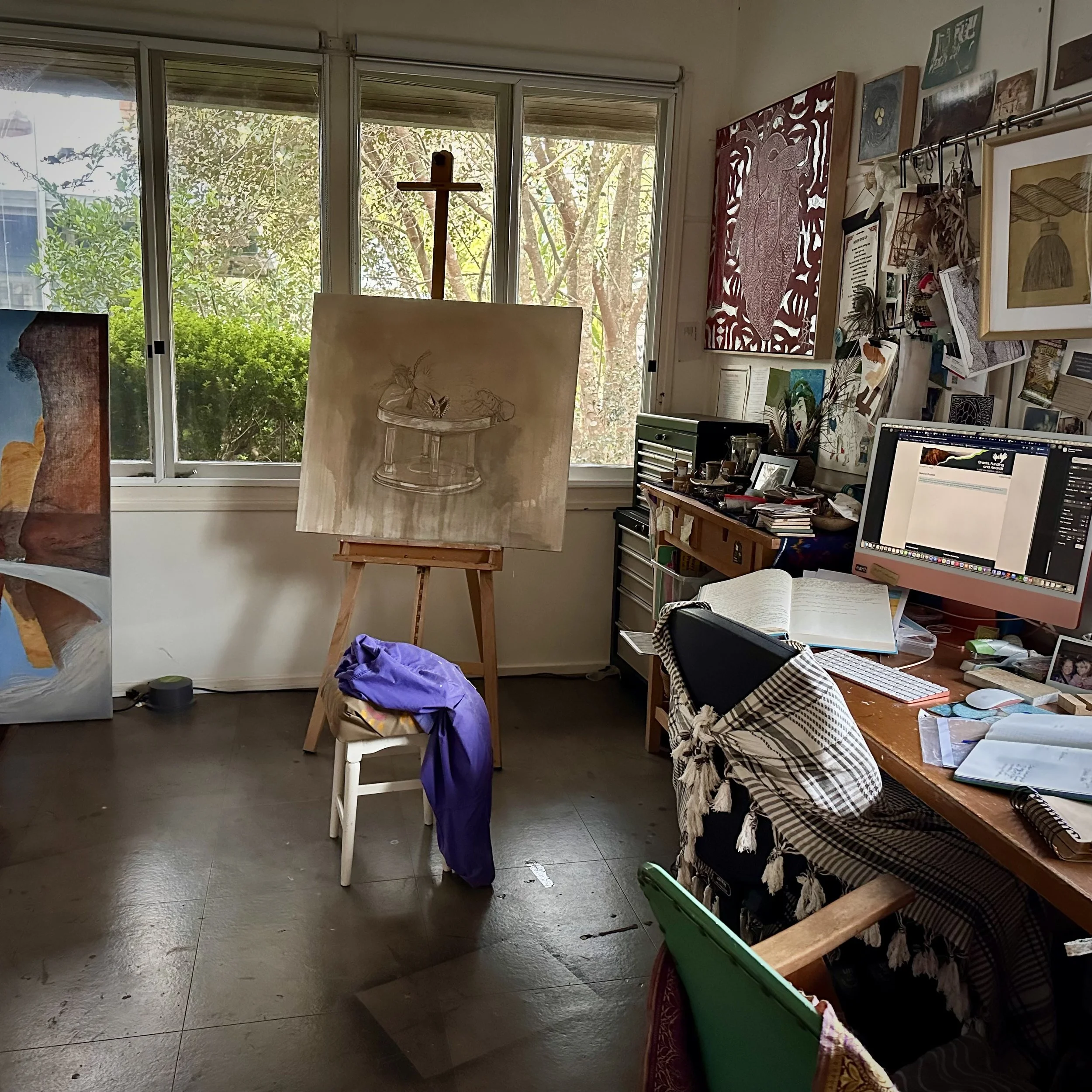
studio in waiting- works in progress
September has brought a season of judgement in so many ways. Of the art world, galleries, local arts, art awards, funding applications, art itself and, finally and mostly, of myself.
Let me begin.
I drive to a small town to the west to judge the local art prize. 3D, 2D, youth. The work is encouraging and the sale prices small, but the reward of being shown, the feeling of pride and connection to place in the farmers and students holding the brush, is immense.
Judgement.
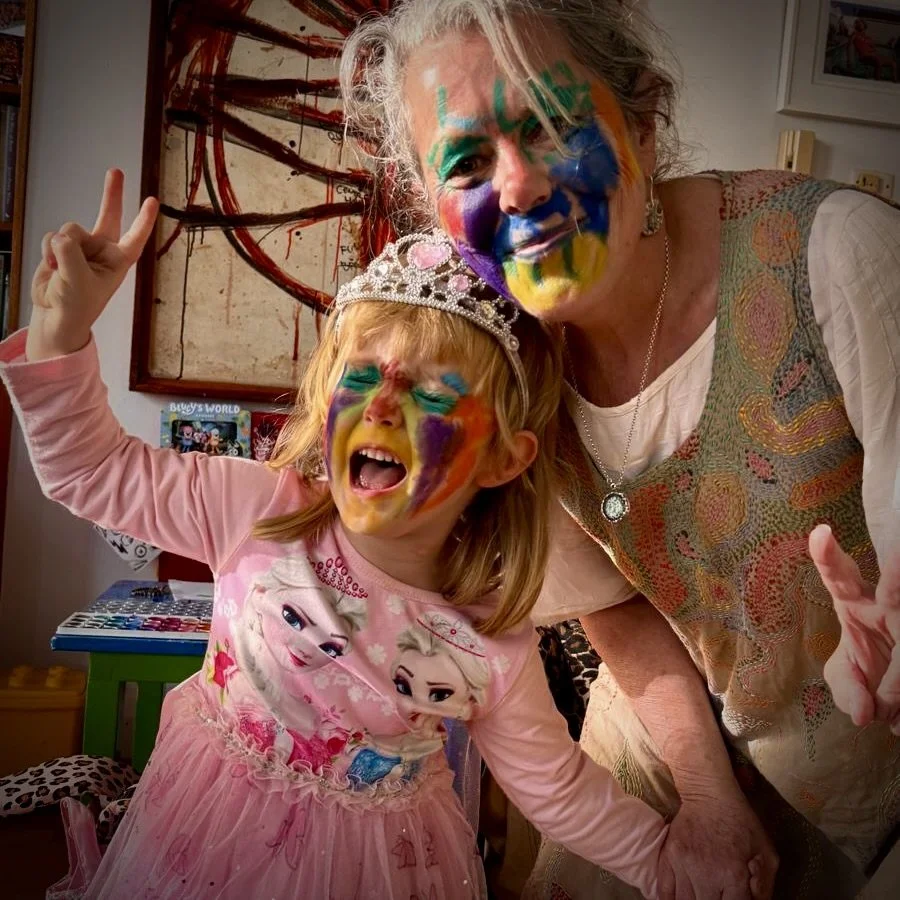
face paint fun
Then I find myself in Sydney on grandmother duties.
It is a delight to witness the raw, unbridled creativity and imagination of a three-year-old. There is no apparent concern about whether something is good enough, whether it is resolved, whether someone else will approve. There is simply the urge to make.
Down the road, Sydney Contemporary is on at Carriageworks.
On my way there I am distracted by an artist-run initiative and become ensconced in conversation with exhibiting artist Antonio Ruffino and his work around pareidolia. In essence, what we make of things. Dragons in clouds. Faces on the moon. Expressions on the fronts of cars.
What the eye beholds, and what the mind conjures from what we see.
Judgement.
I run into Kuweni Dias Mendis on her way to the fair. She is in Sydney for her exhibition Riverscope at Firstdraft and I go along to the opening.
Kuweni's work is not simply the physical works and installations in the gallery. They emerge from explorations of Sri Lankan culture, migration, environment and ritual, connected through storytelling and performance. I take time to listen to her story and already have a point of entry.
With some of the other work on exhibition I cannot find that path into relation or understanding.
My first response is that something hasn't quite resolved.
But is the work unresolved, or have I simply failed to find my way in?
Judgement.
I walk to the Museum of Contemporary Art to see Tony Albert's Not a Souvenir.
Powerful. Brilliant. Concept, design and execution working together. His examination of contemporary and colonial Australia, and the commodification of First Nations imagery in expressions of Australian-ness, says far more about Australian attitudes than it does about First Nations people.
I come away thinking it is one of the most meaningful exhibitions I have seen in years.
Judgement again.
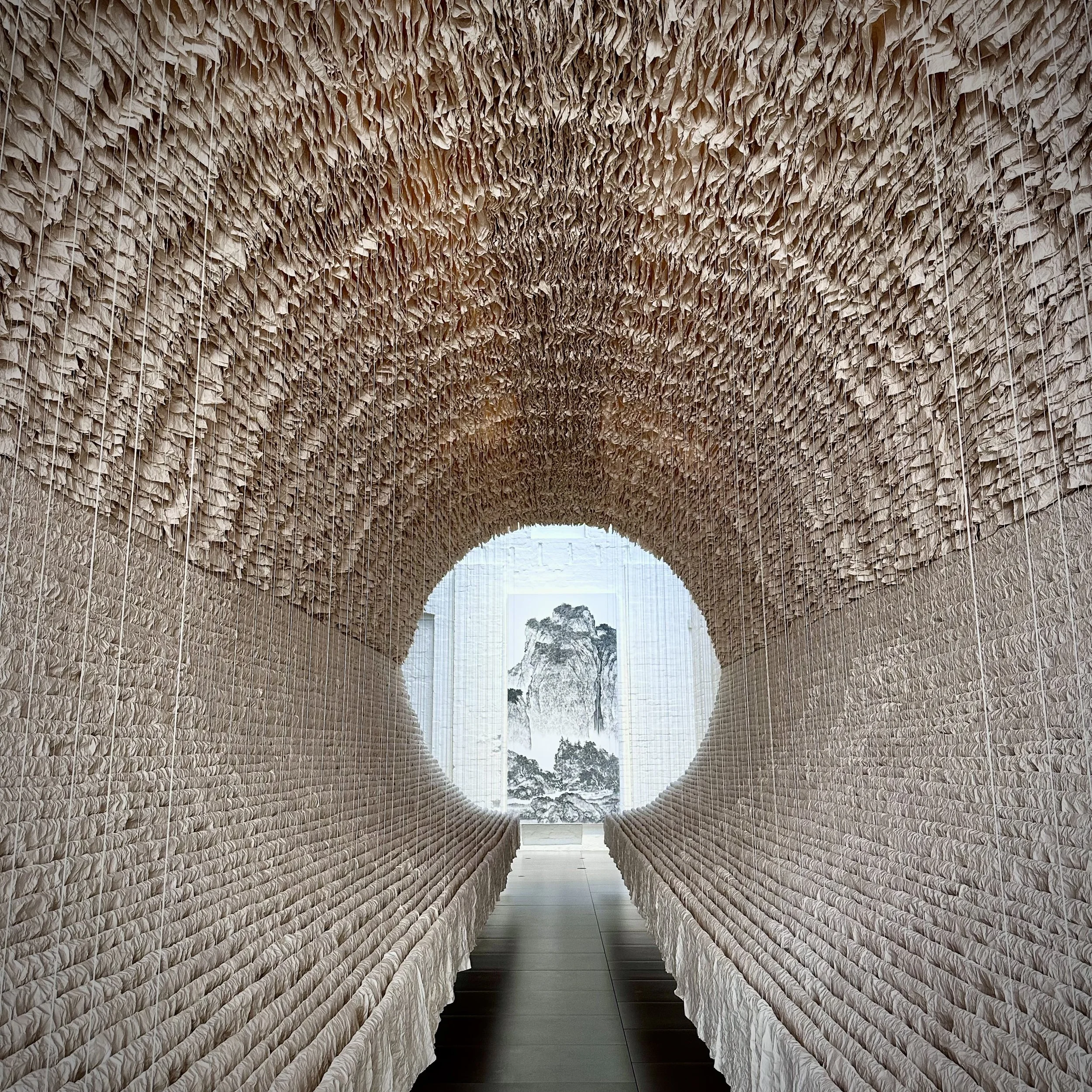
Zhu Jinshi's The Ship of Time
At White Rabbit Gallery I enter through Zhu Jinshi's The Ship of Time: handmade rice paper, crinkled and draped over rows of bamboo suspended by string. An orchestral arrangement of shape, texture and line. Shadows shift with the moving daylight and the smallest breeze.
Then Fu Xiaotong's Spiritual Mountain. Mountains formed on handmade Xuan paper, painstakingly perforated with hundreds of thousands of tiny pinpricks. The language of the needle on paper. The work took more than a year to complete.
The result is not simply impressive. The repetition of piercing the heavy paper becomes an act of making, meditation and veneration.
I think about material. Time. Repetition. The things we ask our hands to do in order to make an idea visible.
Judgement.
The weekend comes and I finally get to the art fair, curious not only to see the artwork but to see what galleries are showing. Who they represent. What they think matters.
As expected, the price tags are high and many of the names well known. The in-crowds jostle with collectors, students, art lovers and tyre kickers while anxious gallerists attempt to discern which is which.
It is overwhelming. Sensory overload.
I come away equal parts inspired, daunted and confused, armed with business cards and flyers and wondering:
Where do I fit in?
If at all.
Judgement.
A few days later I am home.
I walk past native frangipani, early morning bird activity, sun glinting on distant Gold Coast waterways.
Funding news arrives.
Budgets. Values. Support material. Goals. Applications. Things to organise.
The studio quietly waits.
Next I am off to Gympie with my story, my art, my perspective.
More news arrives. Thanks, but no thanks, to various art opportunities.
Judgement.
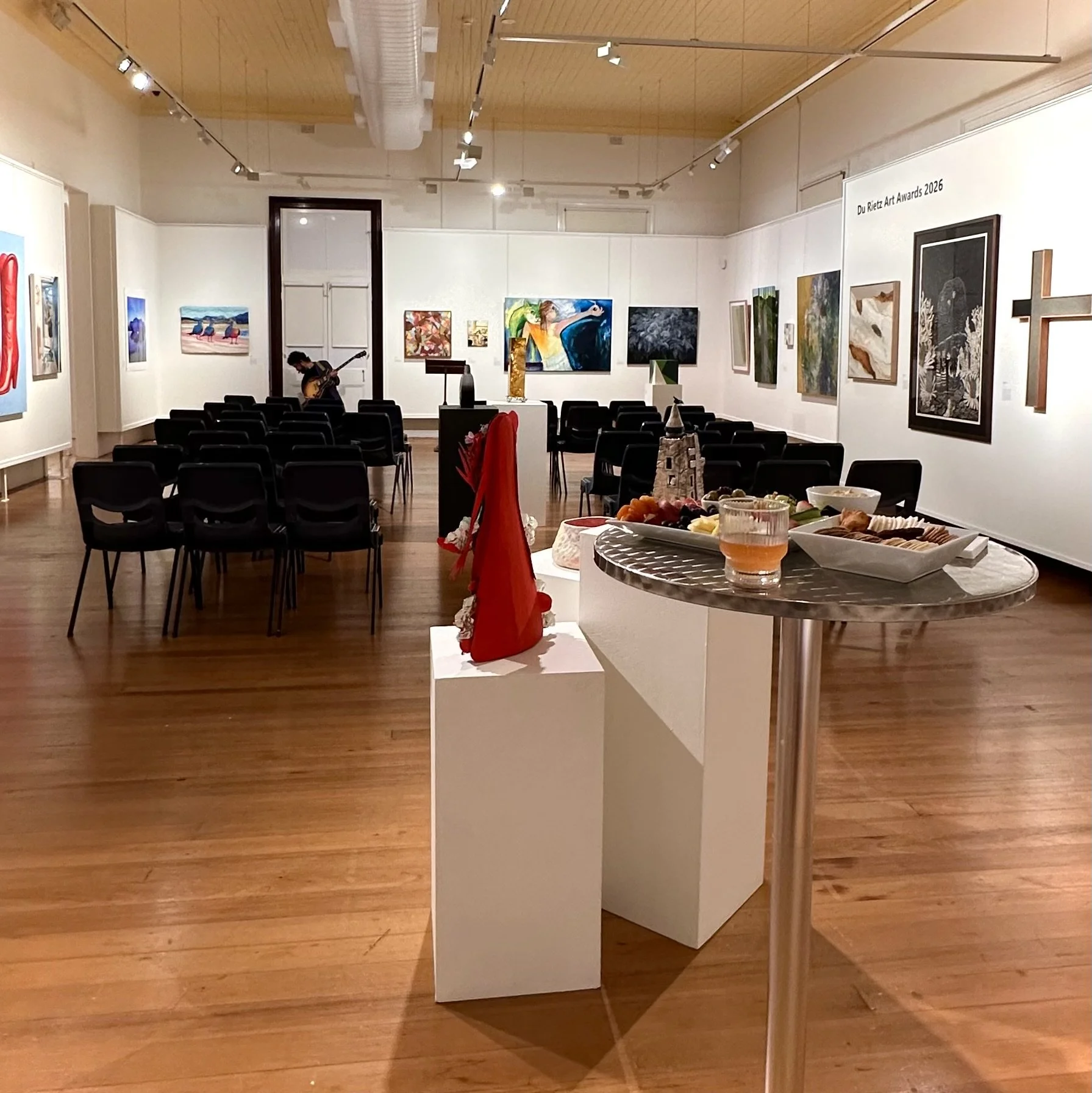
Opening night before the doors open - Du Rietz Art Award
Then I find myself on the other side of the equation, judging the Du Rietz Art Awards with two experienced peers.
The choices are difficult.
I can see skill and technique. I can see concepts. But I am looking for the point at which those things come together. Something more difficult to define. How the work meets me. Whether I feel it before I begin explaining it.
We make our choices.
Judgement.
I give an artist talk about my own practice, about following ideas from concept through making to completion and exhibition. The room is full of artists.
We understand each other.
Lots of nods. Appreciation. Recognition.
I am where I am. This is where the work is taking me. Who knows exactly where.
But increasingly I wonder why I feel the need to know.
The awards night comes and Gympie Regional Gallery is packed. Aunty Debra Bennett gives the Welcome. I first met her more than thirty years ago, when she worked for QCAN, and her words still move me.
Winners are announced.
Smiles, agreement, disappointment and pride mingle in the room.
The next day I give the judges' floor talk. My more eloquent fellow judges are unavailable, and I hope I can convey the depth of consideration behind the choices we made.
Judgement.
And it is still only the middle of September.
Six of us meet to work through a funding application: taking Scenic Rim artists to Jan Manton Artspace in Brisbane, a members' exhibition during the Arts Trail, the development of Arts Trail LIVE and a multi-performance exhibition event at HOTA.
It's a lot.
What to include. What to leave out. How it will work. Logistics. Budgets. Outcomes.
The studio quietly waits.
In Gympie I catch up with an old colleague, Luke, from RASN. We swap stories and he remarks that I haven't slowed down.
Judgement.
He's right.
There is a tension between being an artist, making a living, doing the business hustle, being an arts advocate, curator, producer and administrator, and spending hours in front of a canvas unburdened by all those extraneous matters.
But what if my practice is all of these things?
The canvas. The works on paper. The writing. The curator. The producer. The administrator. The activist.
Perhaps the question is not simply:
Where do I fit?
Perhaps it is:
Why do I still feel I need to fit?
And there is another question beneath it.
How do I protect the quiet space in which the work itself is made?
September is also SWELL season, the sculpture festival at Currumbin.
Sandwiched between deadlines and studio work, I head to the coast on a glorious day. With friends old and new we meander through the sculptures, reading the blurbs and becoming armchair adjudicators ourselves.
Does the work match the words?
Is the idea clear?
Does the material carry it?
Is it...
resolved?
There is that word again.
Resolved.
I start thinking about what we mean by it.
A problem settled. A question answered. Something satisfactorily concluded, explained or cleared up.
But who decides when something is properly resolved?
The artist?
The curator?
The judge?
The critic?
The audience?
Does resolution require agreement?
And what exactly are we asking an artwork to resolve?
My own inner critic starts circling.
Does my work resolve anything?
Climate change. Progress. Our relationship with the land. What has gone before and what continues to surface. The seeming erosion of humanity and compassion in the world.
A growing despair sometimes enters the room of my psyche.
My instinct is familiar.
Do something.
Make something.
Organise something.
Fix it.
Resolve it.
But what happens when the question is too large to resolve?
Perhaps this is where I have been asking too much of art and, perhaps, too much of myself.
A painting cannot resolve climate change.
A stitched line across an old map cannot repair what has been done to a landscape.
A portrait of a tree cannot settle the histories it has witnessed.
Perhaps resolution is not always the point.
Perhaps sometimes the work can hold a question rather than answer it.
Make something visible.
Ask us to look again.
Create a place in which attention can gather.
Allow uncertainty to remain.
I think again of that three-year-old making things in Sydney without asking where they fit or whether they are sufficiently resolved.
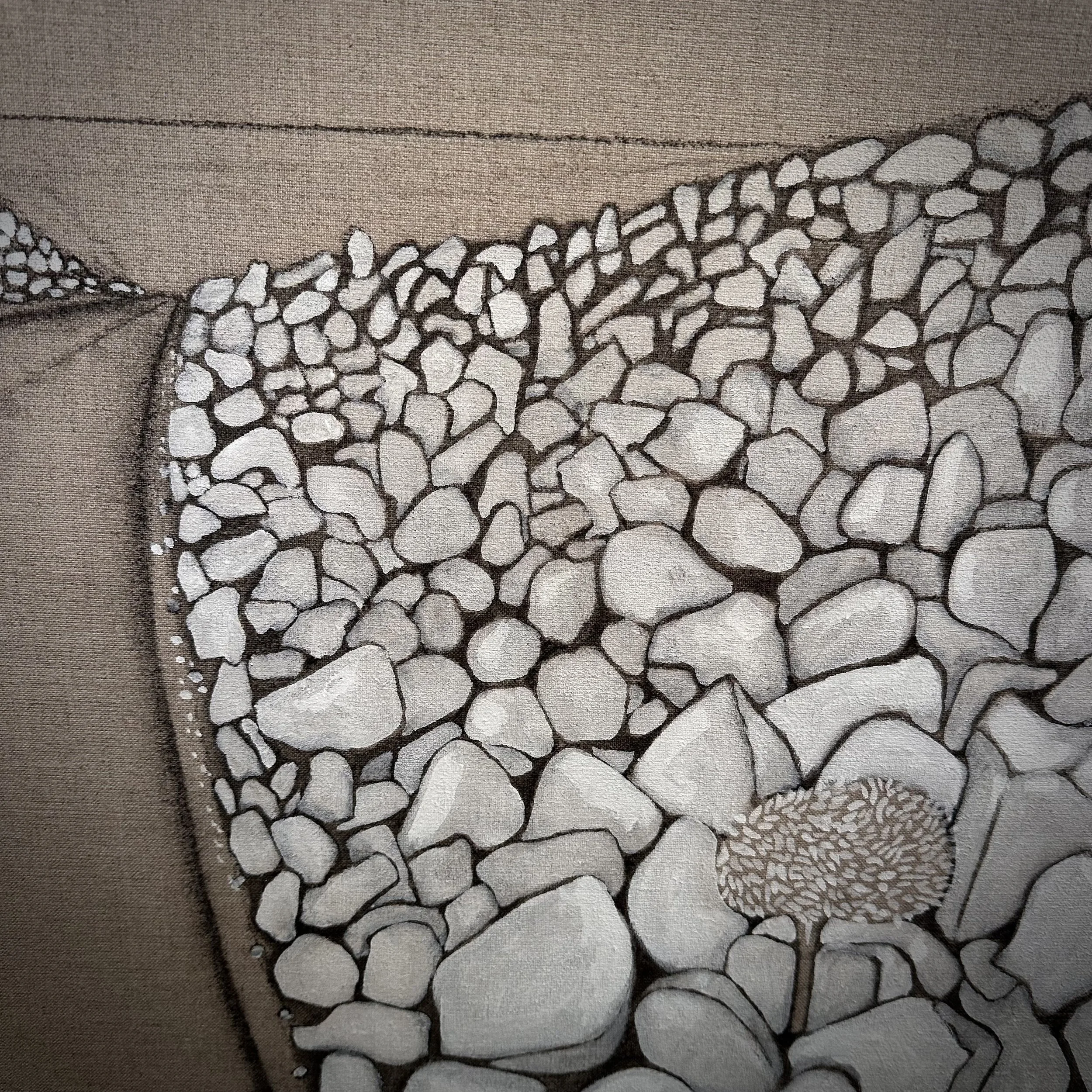
Detail Murujuga Work in progress.
And I think about my own studio.
The canvases waiting.
The maps.
The threads.
The stories still asking to be followed.
Perhaps the studio has not been waiting for me to resolve everything.
Perhaps it has simply been waiting for me to come back.