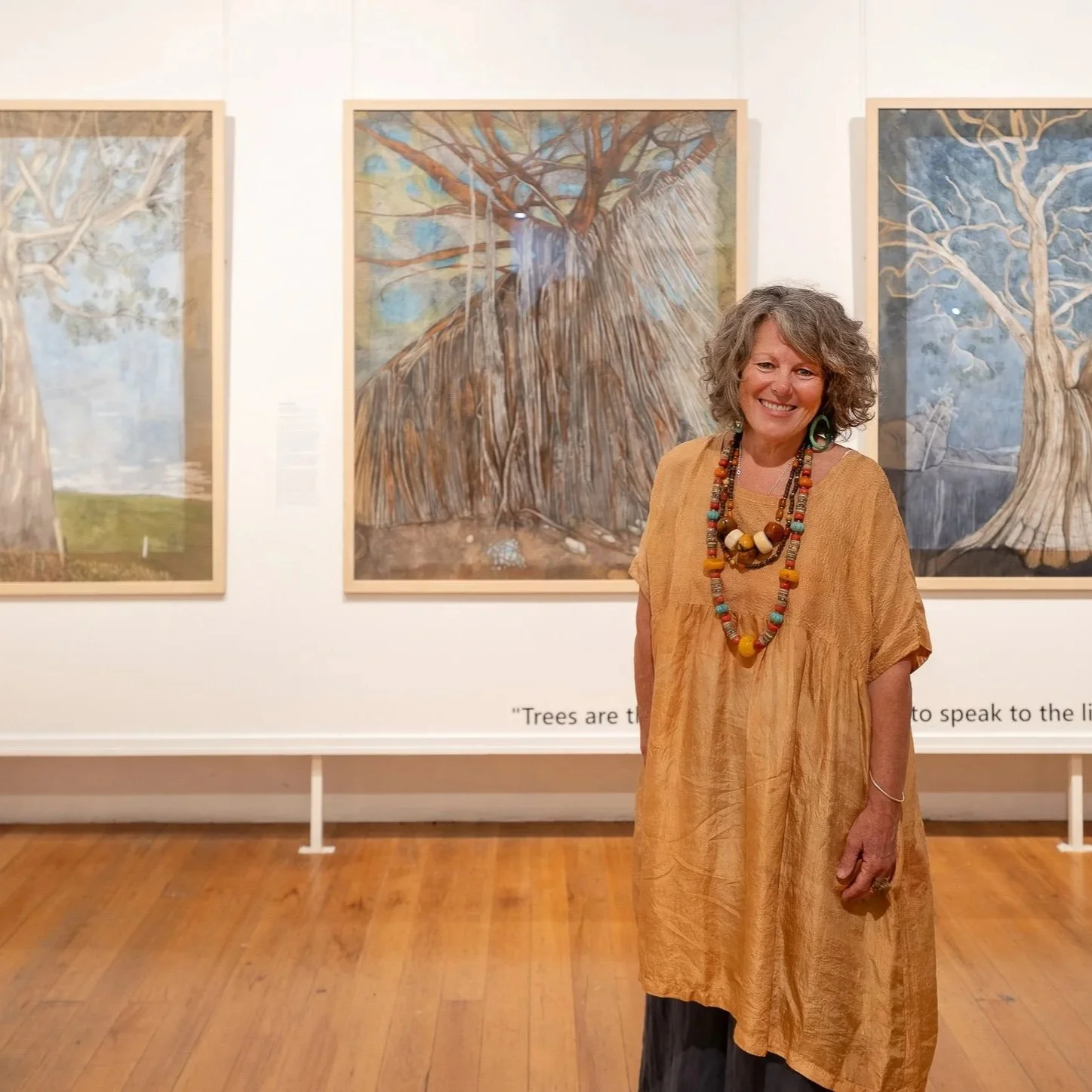
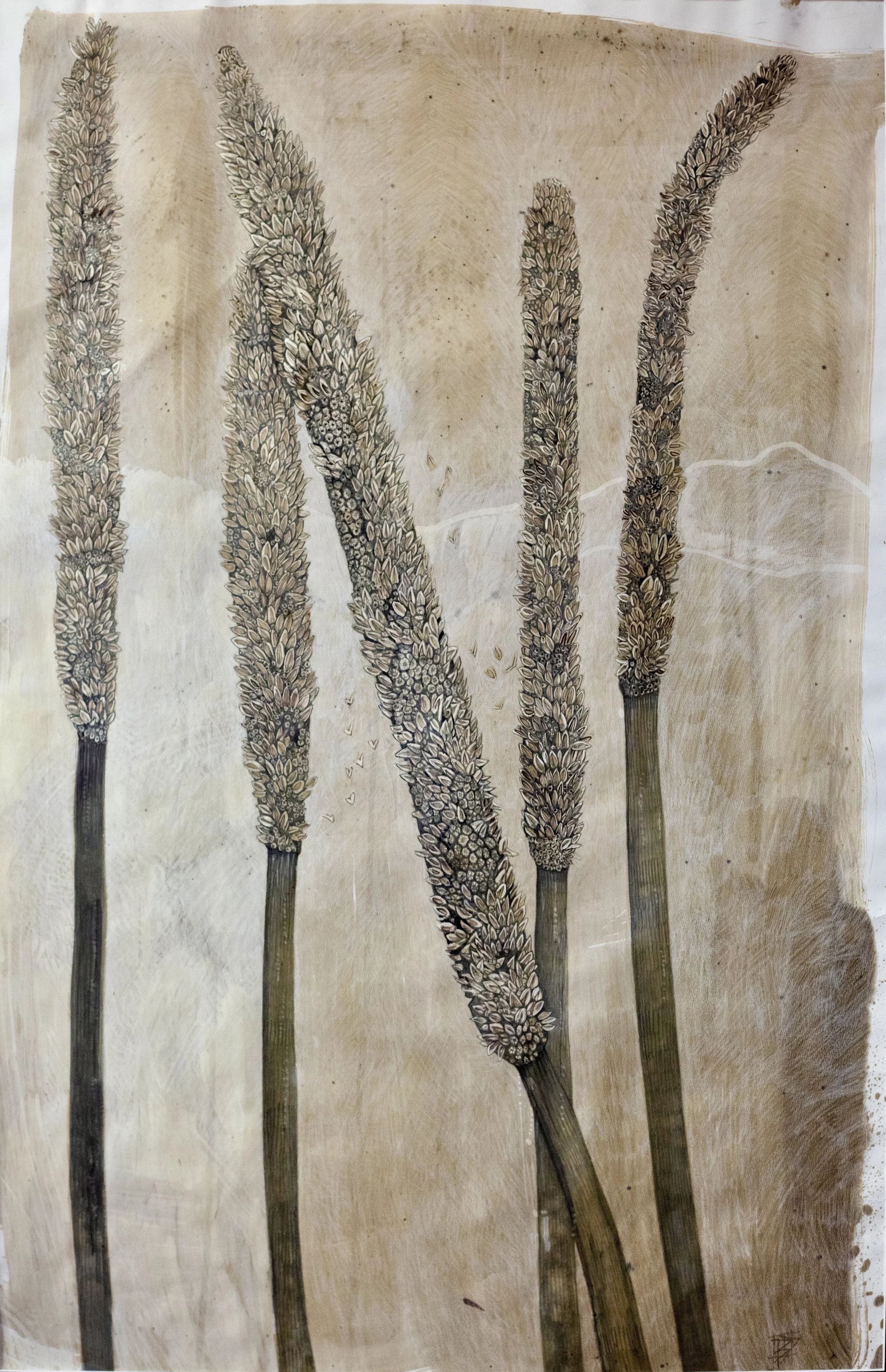
The Whisper in the Leaves, is a touring exhibition in which I have 14 works. I explore the stories held within iconic Australian trees through layered drawings made with natural inks, charcoal, and vintage maps. My works trace the emotional and cultural histories embedded in the landscape, revealing trees as witnesses to love, loss, resilience, and environmental change. The Whisper in the leaves is a collaborative exhibiton with Joolie Gibbs and Shelley Pisani.
The touring exhibition opens at the Gympie Regional Gallery Friday 28 November 2025 More info HERE
into my arms
2024
Graphite paint and gouache on vintage map of Phillip Island,
Victoria Moonah trees (Melaleuxa lanceolata), Phillip Island, Victoria
These majestic trees have been twisted and sculptured by time, with some trees being over 300 years old. Legend has it that among the Boonwurrung people lived a boy and a girl who had fallen in love. They spent every minute tightly embraced in each other’s arms, neglecting their tribal responsibilities and were banished from the tribe. The lovers left together so they could be alone in their tight embrace. Eventually, they froze in place leaving the twist of their entwined bodies to become the wrapping trunk and branches of the Moonah tree. The amazing Moonah can tolerate salt, fierce coastal winds and dry conditions, while providing shelter and roosting sites for an array of birds and other native wildlife. Moonahs are considered endangered on Phillip Island
2024
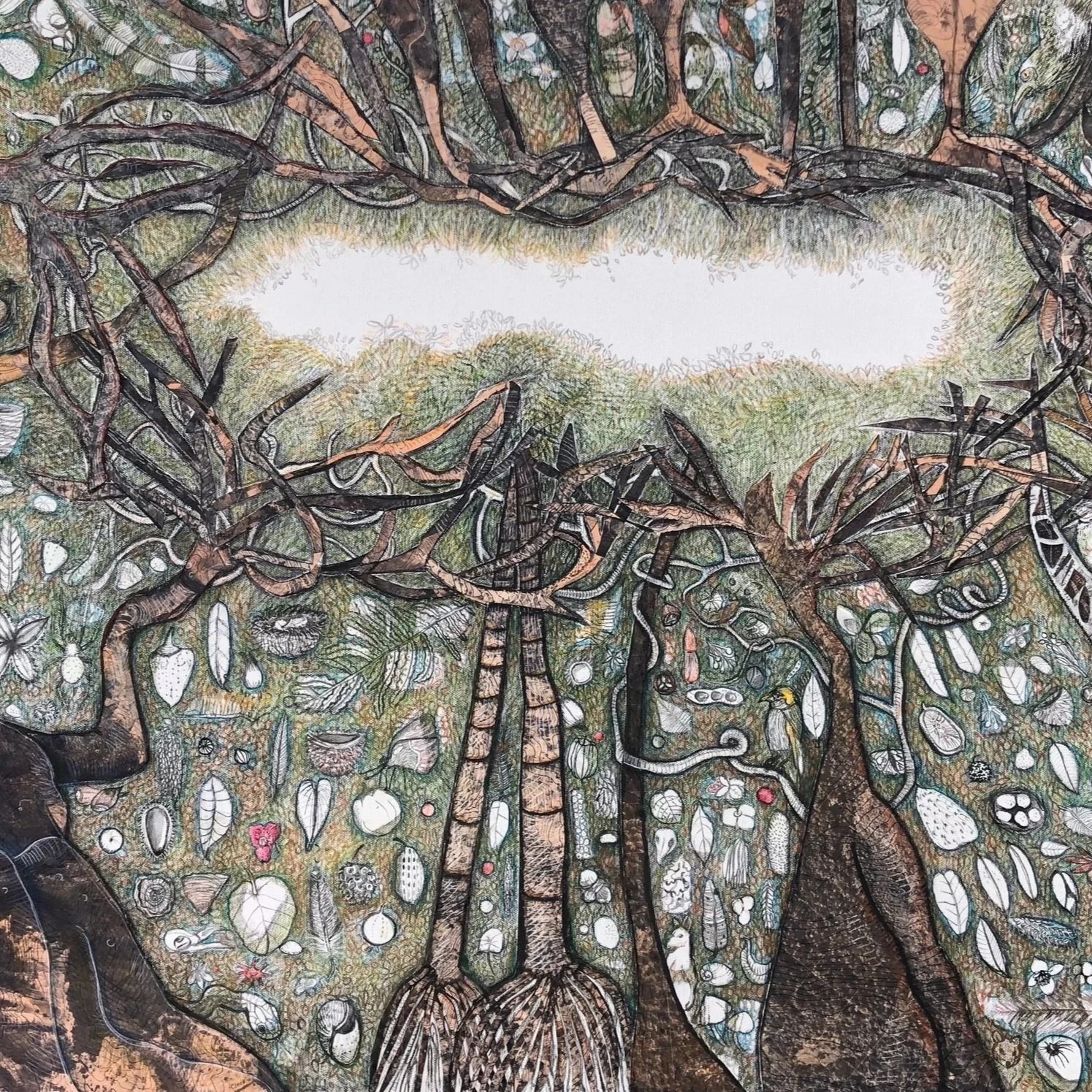
Natural inks, pigments, gauche, watercolour, graphite paint on acid free paper
Curtain Fig, Ficus Verens, Yungaburra, Atherton Tablelands, Queensland
There is a quote by Bengali poet and philosopher Rabindranath Tagore that goes, "Trees are the earth's endless effort to speak to the listening heaven."
From the heavens, a bird flying above the canopy drops a seed, which lands in the branches of a host tree. The seed sprouts vertical roots that gradually become thicker and more interwoven. Hundreds of years pass, with the roots strangling the host tree, which eventually falls into a neighbouring tree. More vertical fig roots form a curtain, while the host tree rots away, leaving the curtain fig freestanding. This tree is thought to be nearly 50 meters tall, with a trunk circumference of 39 meters, and is estimated to be over 500 years old.
It is said that certain Indigenous communities would lay the body of the dead at the base of a strangler fig and tie its roots and tendrils around the body. In time, the body and bones would be absorbed into the tree, the roots growing and encasing the human remains—a living headstone.
The Curtain Fig stands in a remnant of the Mabi Forest (named from the Aboriginal word for the Lumholtz’s tree kangaroo). This forest type has several unique features, including semi-deciduous canopy trees that allow more light than usual to penetrate to the forest floor. It is endangered because most of this forest type has been cleared for farming. The area around the Curtain Fig is full of basalt rocks and was not considered suitable for agriculture. Although these remnants are now officially protected, they remain threatened by feral and domestic animals, invasive weeds, and the effects of isolation.
The Mabi Forest was home to the Ngadjon-ji and Yidinji Aboriginal tribes and holds spiritual significance for them.
To me, this tree represents strength, a song to a distant future, and a reminder of nature’s fragility and our role as custodians.
2023
Graphite paint and charcoal over map of Queensland.
Mastwood, Calophyllum inophyllum, Cooya Beach, Queensland
Old we are—holders of time, wind, seas, and story.
Old we are, still standing after the last big blow. Our limbs grow long and thick, cracked and dark. We beckon and nod to Hinchinbrook, though we don’t recognise that name. To us, it is Banjin—storm coming.
We, and the mangroves, keep this land rooted in place. We stitch the sky to the sea, to the earth.
Long before white fellas came, many tribes gathered under our shade, the women gathering our seeds and fruits. We have many uses. The oil from our seeds was treasured to ease many ills when absorbed through the skin. Our branches yielded strong timber for canoes and shelters. Some call us mast wood.
We are strong.
We cling on.
We can weather all the storms.
We survive—no, we thrive.
2023
Charcoal, pastel, watercolour and graphite paint over map of Gladstone.
Moreton Bay Ash, Corymbia tessellaris, 1770 Eurimbula National Park, Queensland
I am Goranja—Goranja for Kabi Kabi, and to them, I am part of their family, bound by kinship ties. My trunk is dark, cracked like the skin of a reptile.
I am as old as the dinosaurs.
I guard my roots and lower reaches, protecting my lignotuber, ensuring I survive fire and drought.
My torso is elegant, twisting, dancer-poised, opening skyward far beyond where I meet the ground.
I grow with my kin and the kin of other kin.
We know the old people, those who treated us with respect, who took only what they needed— for medicine, for canoe, for the warmth of shelter.
They took but did no harm. They too are kin of our kin.
One day, white men rowed to shore.
They looked—but not hard enough
to see the water we protect, the abundance we store.
They came, they collected, they left.
We were charted, diagnosed,
and a different story began.
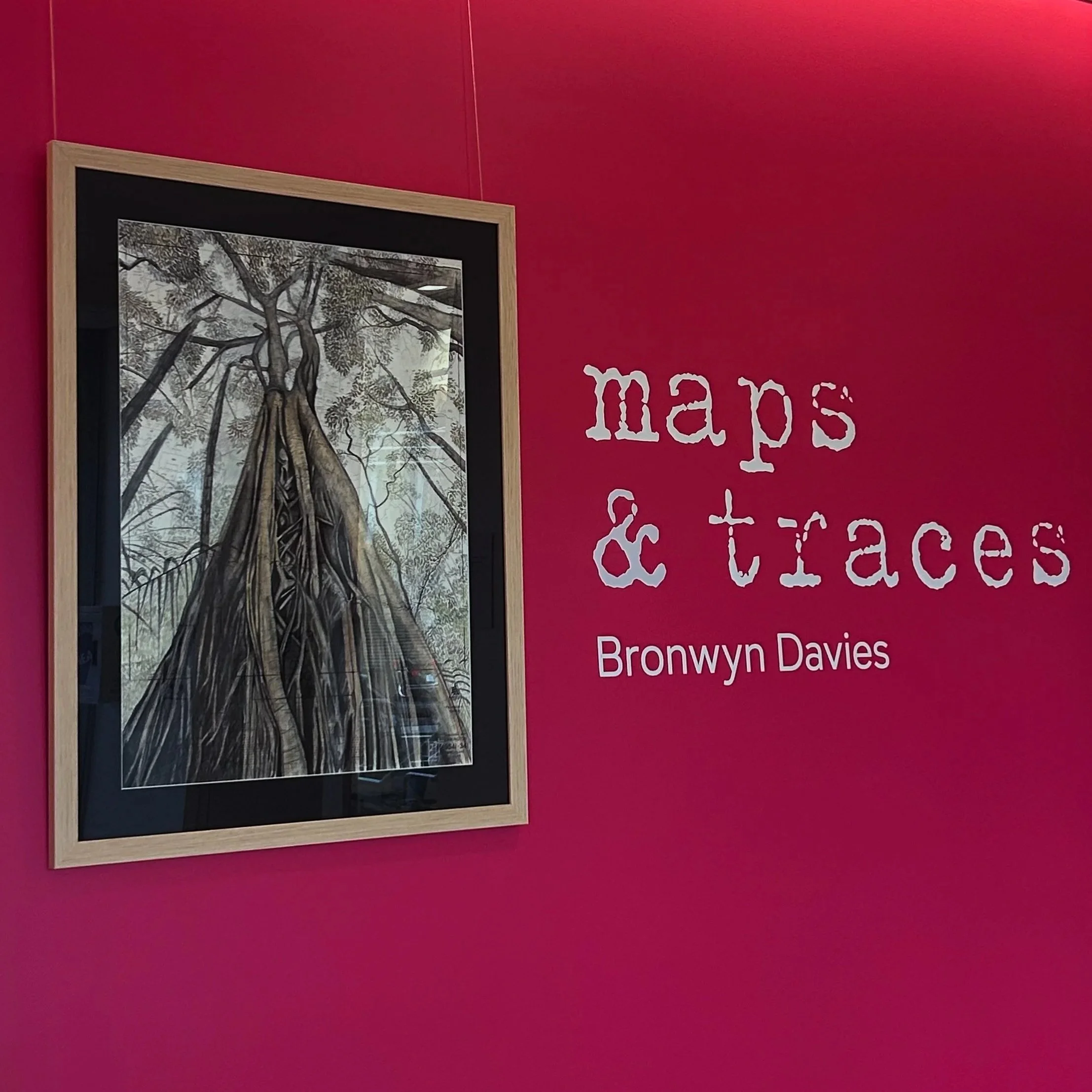
maps & traces 8th Februray 2025 until 17th April 2025 at the Centre Beaudesert
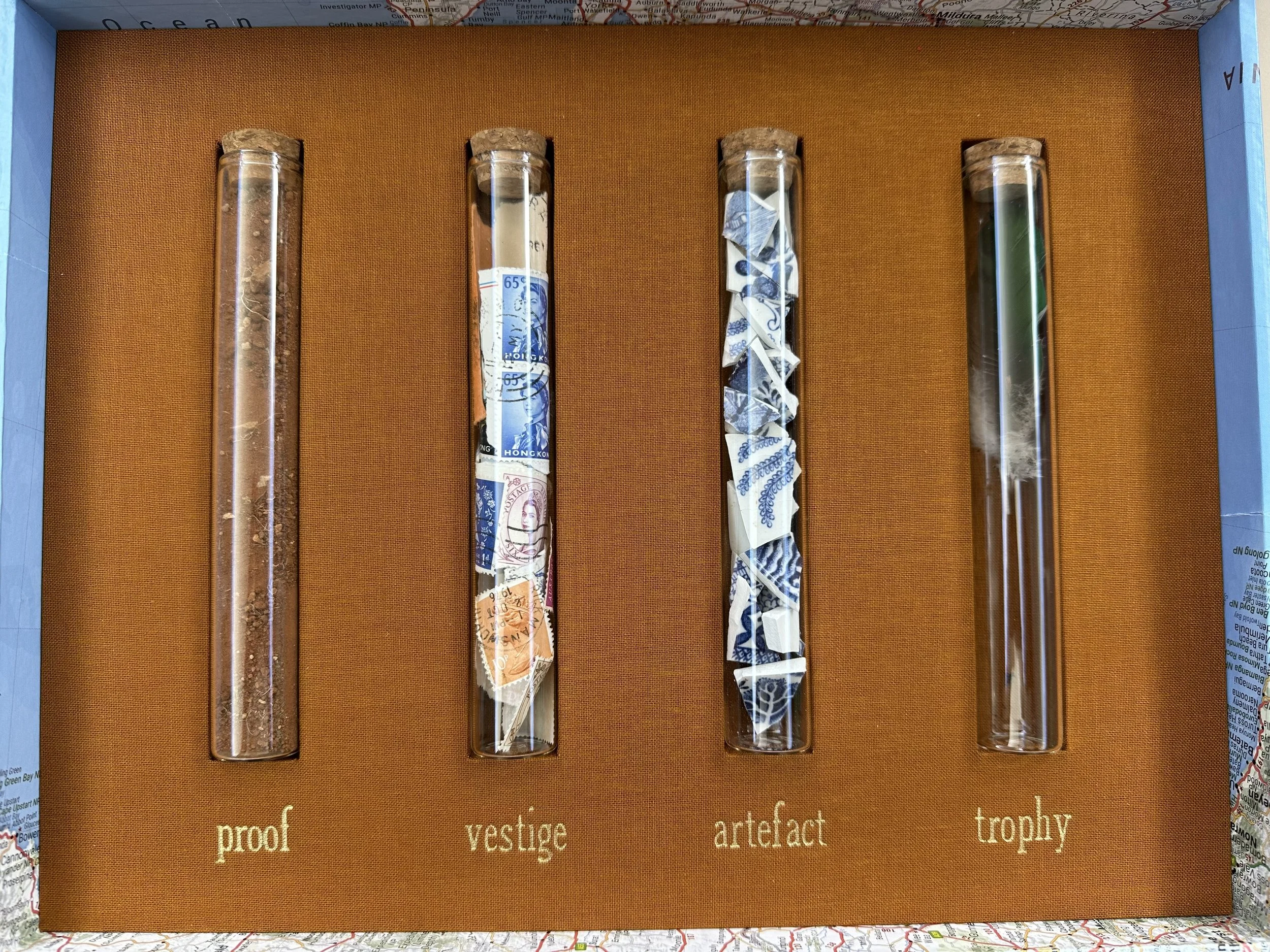
Maps and Traces takes us on a journey into Australia’s natural history and its complex relationship with the environment.
Charcoal, handmade paints over a vintage cadastral map of Lamington.
Acrylic inks over ortho-photographic map of North Tamborine.
Acrylic inks over orthophotographic map of North Tamborine
Natural inks, gouache, graphite paint and watercolour over map of Lane Cove National Park
Acrylic inks over ortho-photographic map of North Tamborine
Natural inks and gouache over cadastral map of Mount Barney.
Acrylic pen pastel on paper
Artist Statement
Drawn from the Forest is a collection of works from various forests I have met in my travels. I say met as they each have their own identity and have left memories and marks on my psyche.
From time spent with the forest defenders in the Tarkine , Tasmania at the Bob Brown Foundation's Art for takayna event to the alpine forests of Victoria and New South Wales and back to the rainforests I am blessed to live amongst on Tamborine Mountain.
My work has become more meditative than ever. In a world buffeted by challenges returning to nature, to listen to the sound of birdcall and the wind, to notice what is flowering or what seeds are littering the forest floor is a balm for the soul.
It is a privilege to have the time and space to reflect on nature through the creation of art and an honour for me to share it with you.
View the most recently updated catalogue here
Mixed media drawing on paper
Banksia serrata plants generally become fire tolerant by five to seven years of age in that they are able to resprout afterwards.As with other species in the genus, B. serrata trees are naturally adapted to the presence of regular bushfires and exhibit a formof serotiny known as pyriscence. The seedbank in the plant's canopy is released after bushfire.
Mixed media drawing on paper
Angophora costata- commonly known as Sydney red gum, rusty gum or smooth-barked apple, is a species of tree that is endemic to eastern Australia. Reaching 30 m (100 ft) in height, the species has distinctive smooth bark that is pinkish or orange-brown when new and fades to grey with age.
Mixed media drawing on paper
Nothofagus cunninghamii, commonly known as myrtle beech or Tasmanian myrtle, is an ancient relict that was present in Gondwanan rainforests and today grows across the Southern Hemisphere.
Nothofagus - from the Greek nothos, meaning false and fagus, referring to the original belief that this genus was related to Northern Hemisphere Beech (Fagus) trees cunninghamii - after the 19th Century botanist Allan Cunningham
Mixed media drawing on canvas
Under a takayna moon
The artists gather
To bathe in the awe
Of stringybark giants
Drinking in
The mystery
Mixed media drawing on canvas
Under a takayna moon
we stretch our arms wide
fifteen souls reaching
to unfurl you
in an embrace
that does not stem
the flow of tears
Mixed media drawing on canvas
Under a takayna moon
giants loom above
memory of the felling time
whispering through the branches
The missing
a gap in the sky
Mixed media drawing on canvas
Under a takayna moon
The song of the night
rich
with cries of survival
blends
with scent laden mist
seeps into the blood
the cup filled
Mixed media painting on hand made Nepalese paper
In the Palm Grove section of Tamborine National Park. Pademelons scurry, Wompoo pigeons and Cat birds call, at the bottom of the track at the bottom the Picabeen palms dominate. Their aerial roots exposed above the soil surface to absorb oxygen when the soil is flooded or waterlogged.
I live amidst subtropical rainforests, giant stands of ancient gums and cedars.
I have great respect for these sentinels. The lives lived in and around them.
Lately I have seen the forests burn.
We don’t know what we have got till it’s gone.
Watercolour on cotton rag
I had noticed that at the end of the knoll there are two trees whose branches had fused together. I thought of them as needles, portals to the sky. Later I came to know they had much significance to the first nations peoples of this country- to the Wangerriburra people and those travelling through this land.
BEAUDESERT SIGNPOST, 2021
pen and ink on topographic map,
I have been driving the road to Beaudesert off an on since I was a youth project worker for Beaucare in the 1990s. As I came to know more about the Indigenous culture of this region I began to understand the significance of the area I drove through every day.
This Ring Tree would have been a sign post. It is said to be a border tree for five tribes.
mixed media drawing over topographic map
First Nation Australians used to weave together the branches of the young trees in order to mark places of significance. As the trees grew, the branches then fused together to form rings.
So-called “ring” trees are significant cultural markers for Aboriginal communities.
water colour on cotton rag
In December 2019 we found ourselves on a road trip from Queensland via Canberra and Melbourne and then onto Coorong, Adelaide, Sydney and back home.
Leaving Armidale to come home via the Rainforest Way my heart broke.
The ground an ashen white, the limbs bare and not a bird in sight.
watercolour, ink and graphite
Diamond Head as far as they eye can see was burnt. Charred trees, leaves turned brown, trunks laying on the ground, the ground ashen. However, signs of life stoirred, new growth peeped out from charcoaled limbs vibrant red, vivid green grass spikes poked through the ash and grass trees shooting new growth to the horizon.
Watercolour on cotton rag paper
One afternoon during November 2019 the fires were burning in Lamington and Main range National Parks. The air was crackling, the sky was glowing orange through the smoky haze.
It was at once unusual, beautiful and somewhat terrifying.
water colour and ink on cotton rag paper
In 2019, 9000ha - 84 percent - of the Crowdy Bay National park was impacted by fire.
mixed media on canvas with collaged map
Oil on Canvas.
acrylic on canvas
mixed media on canvas with maps
THE FLAME TREE, 2010
pastel, acrylic and graphite
Mixed media painting on hand made paper
charcoal and pastel collage
pastel on paper
charcoal and pastel on acid free paper
charcoal on paper
charcoal, pastel and watercolour
charcoal and pastel on acid free paper