
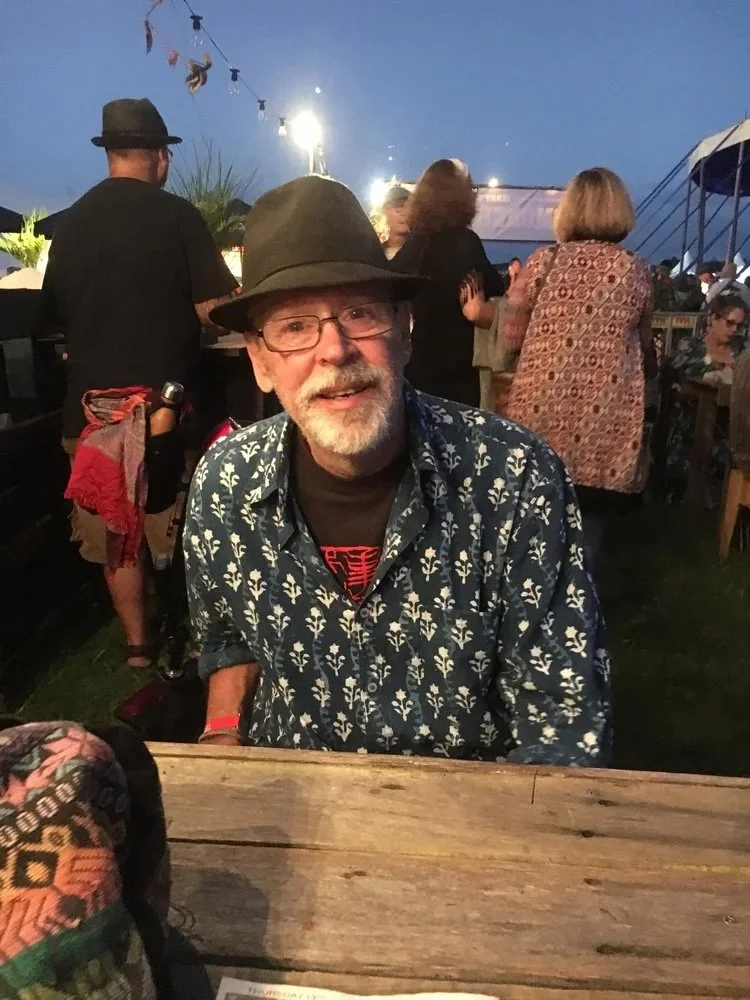
Eulogy 21/3/26
I am honoured to speak today to commemorate David Forbes—not just as a friend and a remarkable person, but as an artist whose vision, imagination, and dedication to light and community touched everyone who experienced his work. I want to share a glimpse of his journey, his creativity, and the profound impact his art has had on all of us.
Between 1975 and 1983, the art scene in the United States—and especially in Berkeley, where Dave studied at the University of California—was politically charged, experimental, and still deeply shaped by the 1960s counterculture. During that time, he completed both a Master of Arts and a Master of Fine Arts, studying under teachers like David Hockney and Frank Stella.
Dave began with printmaking and large, atmospheric abstract paintings, exploring how light moves across the landscape. In between, he rode a motorbike across 49 U.S. states and travelled through Canada and Mexico. His paintings, however, were considered too “quiet” to secure a show. Undaunted, and still drawn to light, he moved to Wisconsin to learn the art of bending neon—a skill that would come to define much of his career.
In Dave’s own words: “In 1984 I turned my attention to the use of neon as an artistic medium and quickly became enamoured with both the light and colour… For the next six or seven years, my work was all about light. We see light all the time, but we seldom experience it.”
David Forbes wasn’t working in isolation. He was part of a moment when Andy Warhol was reshaping how we see image and culture, when Bruce Nauman and Dan Flavin were turning light into language and form. It was also a time of new voices—when Jenny Holzer carried words into the street, when Jean-Michel Basquiat painted with raw urgency, and when Robert Rauschenberg continued to open doors between art and the world around it.
In that mix, Dave chose light—but in his own quieter, more poetic way, exploring its character, strength, and the way it shapes colour.
At age 37, he moved to Australia, and by 41, after establishing a new arts practice in Queensland, marrying, and having two young children, he was diagnosed with Parkinson’s.
I first met David and Janelle on Tamborine Mountain. Dave’s work Miracle—a full-body fibreglass cast of his very pregnant wife, lit with neon—was part of an arts festival I coordinated with my friend Joanna Jouin. It was an arresting, unforgettable piece. I was saddened when they moved to Brisbane after three years so Dave could be closer to medical support, but his commitment to his art never faltered.
After Parkinson’s entered his life, the way he worked changed, but his dedication did not. Where once he painted and bent neon with his own hands, he began to draw, to imagine, and to collaborate—working with others to bring his ideas into the world. In many ways, his work grew larger, more ambitious, and more connected.
He created public artworks that brought together light, architecture, and community. These included Cascade at the Bremer Institute of TAFE, with its cast resin discs and neon “spine” symbolising water; Observing the Imaginary at the Charleville Cosmos Centre; DDS: The Bridge at Brisbane State High Library, exploring the Dewey Decimal System in neon-lit digital transparencies; The Star at Upper Coomera State College, celebrating the five disciplines of the performing arts through resin, neon, and light; and The Postcard Project at Brisbane State High School, a community-based work of hundreds of postcards by students, digitised and backlit with neon, capturing life in West End past, present, and imagined.
In 2011, we exhibited Dave’s Under the Radar at the Centre Beaudesert, depicting ten historically, culturally, and aesthetically significant sites interpreted in sculptural form. Aerial photographs formed the starting point for the creative process, resulting in a synthesis of three long-running concerns in his practice: aerial perspective, light, and diffusion.
Throughout all of this, Dave’s fascination with light remained constant, but it was joined by something deeper: a commitment to people, to place, to community. His works didn’t just occupy space—they invited us into it, asking us to see ourselves, and each other, within them. Even as his hands could no longer shape every piece, his vision never wavered. He continued to imagine, to guide, and to inspire.
Dave remained positive, adventurous, and fully engaged. His intellect—though sometimes veiled by the speech difficulties of Parkinson’s—was always sharp, and his wit dry and insightful. He supported me in all my own exhibition work, and above all, he was a constant inspiration.
Go well my friend.
Bron