
Painting Lake Argyle: Reflections on Water, Memory and Place
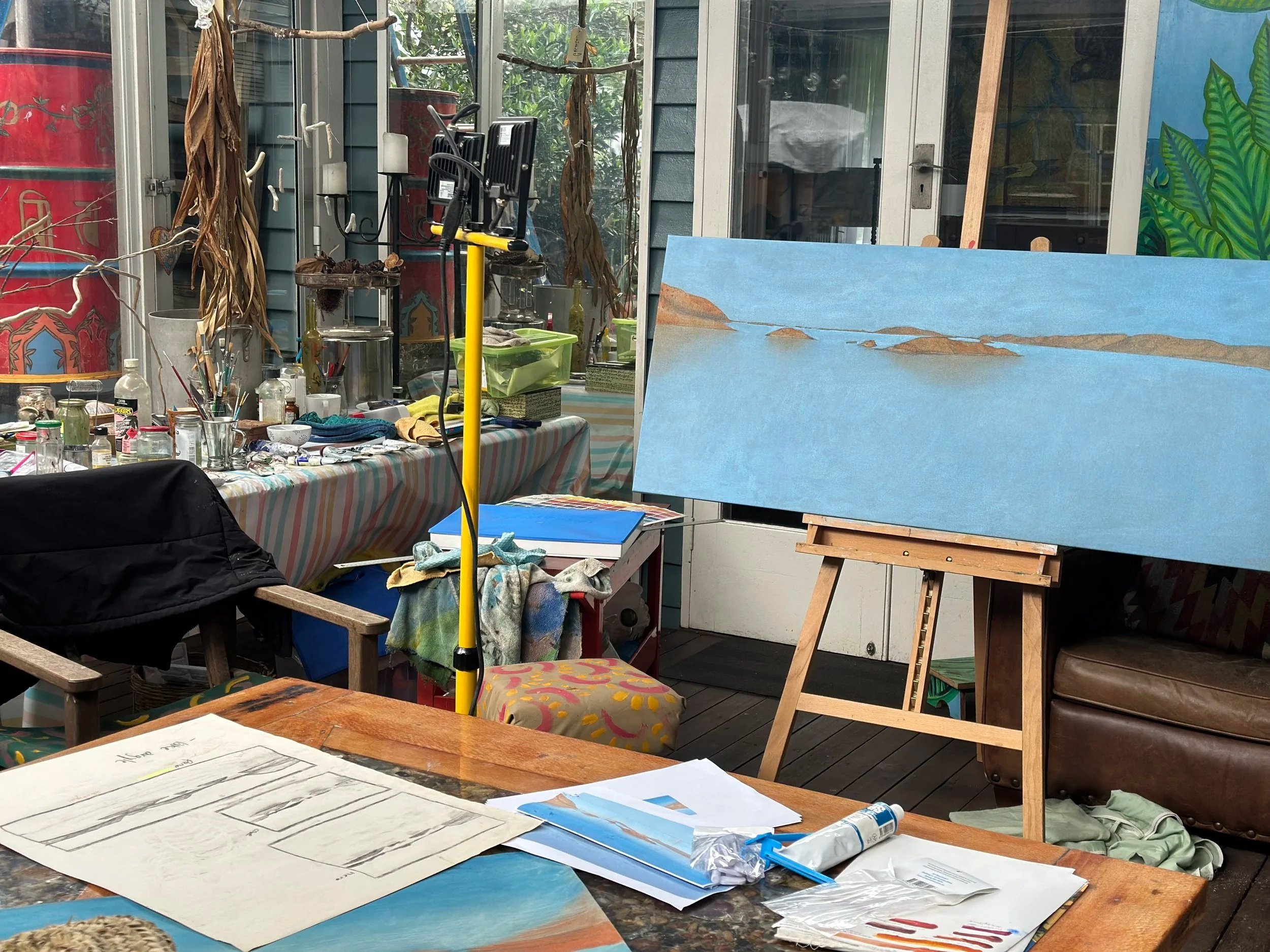
Islands of calm- work in progress in the studio
Too Big for the Canvas
Under vibrant blue Kimberley skies we travelled through plains of boab trees, ranges that announced themselves dramatically against the horizon, and rivers that snaked their way across Country before finally meeting the sea across vast mudflats and salt pans.
The air felt thick with story.
Far removed from the southern seats of power, settlement brought massive change to the Kimberley, the scale of which is difficult to comprehend. Lake Argyle alone covers almost 1,000 square kilometres. Beneath its waters lie sacred sites, burial grounds, places of gathering and memory. Some stories were recorded, others submerged.
Paddling across the lake, it is impossible not to be struck by the beauty of the place. The water glassy and the sky goes on forever. Freshwater crocodiles bask. Birds gather. Islands crowd the horizon.
Islands that once were mountains and hills.
Coves we paddle through, once valleys.
I remember learning about The Ord River Scheme at school. It promised prosperity, capturing water before it reached the sea. Cotton would grow. Rice would flourish. Progress seemed inevitable.
But landscapes have a habit of reminding us that they are active participants in our plans, not passive recipients of them. Cotton attracted pests. Rice crops were devoured by magpie geese. The grand agricultural vision shifted. Today tourism has become one of the region's defining industries.
Nearby, the Argyle Diamond Mine has also reached the end of its productive life. Once among the richest diamond deposits in the world, it now faces the challenge of rehabilitation and return. The landscape continues to ask questions of those who seek to shape it.
As we paddled through the stillness of Lake Argyle, I wondered about the difference between knowledge and wisdom. Not whether we could build such things, but what we might learn from the consequences that unfold long after the original decisions have been made.
Rivers, Memory and Control
While researching giant paperbark trees in Cooktown, I found myself imagining them as witnesses to history. Standing for centuries beside rivers, what might they have seen? What stories would they tell?
In one piece of writing, I gave voice to a paperbark tree reflecting on the arrival of newcomers and the changes that followed:
"I am now in the middle of a park. I used to be by the river's edge. Rivers change, you know. Storms come, silt builds up or washes away, currents shift. Like Mungurru, the rock python, the river twists.
White men like to control that twisting. To build places for boats to tie up, to put factories, build houses. They don't want a river that shifts. They want permanence. Hah!"
The line continues to stay with me.
Rivers move. They flood, change course, carve new channels and erase old ones. Human settlements often seek certainty, stability and control. Yet rivers have long memories.
What the Rivers Remember
Travelling through the Kimberley during the dry season, we could walk across mudflats and trace the paths water had carved during the wet. Deep gorges revealed the power of rivers over immense stretches of time. We visited towns that once thrived as river ports now abandoned, their purpose altered by roads and air travel.
Everywhere there were reminders that landscapes are not static.
They are living archives.
Stories accumulate in layers: geological, ecological, cultural and personal.
Some stories endure. Others disappear beneath water, beneath development, beneath the relentless movement of time.
And yet traces remain.
Back in the Studio
Back in the studio I have been grappling with overwhelm.
The challenge is not creating a piece about Lake Argyle. It is finding a way to hold the complexity of the place within a single work.
Painting and drawing have always been a form of meditation for me. The slow accumulation of marks forces me to pay attention. Looking becomes a way of understanding.
But landscapes are never only physical. They carry histories, memories, competing perspectives and unanswered questions.
Lake Argyle holds many stories.
It is an engineering achievement.
It is a place of cultural significance.
It is a refuge for birds and wildlife.
It is a destination for travellers.
It is a source of livelihoods.
It means different things to different people.
As I make this painting, I find myself wondering how a work can acknowledge these layers without trying to explain them all.
At the easel the canvas waits. A panorama measuring 140 x 60 cm, its long format attempts to contain something of the vastness of the place, its space, colour and light.
Islands of Calm
Recently I listened to a conversation from the Spring Creek Project at Oregon State University. One phrase stayed with me:
Be an island of calm.
The idea seemed particularly resonant while thinking about Lake Argyle.
The islands that now rise from its waters were once mountain ridges and hillsides. Their histories are complex. Their existence is the result of immense change. Yet there they sit beneath impossible blue skies, surrounded by water and light.
As the world seems to hurtle towards uncertainty, I find myself returning to that phrase.
How do we become islands of calm?
Not by withdrawing from the world. Not by ignoring what is happening around us. But by remaining grounded enough to respond thoughtfully rather than reactively.
Perhaps that is one of the questions this work is asking of me.
And perhaps that is what keeps drawing me back to the canvas.
This work forms part of Tracing Australia, an ongoing exploration of landscape, memory, ecology and place through art, storytelling and reflection.