
Reflections on belonging, migration and stewardship
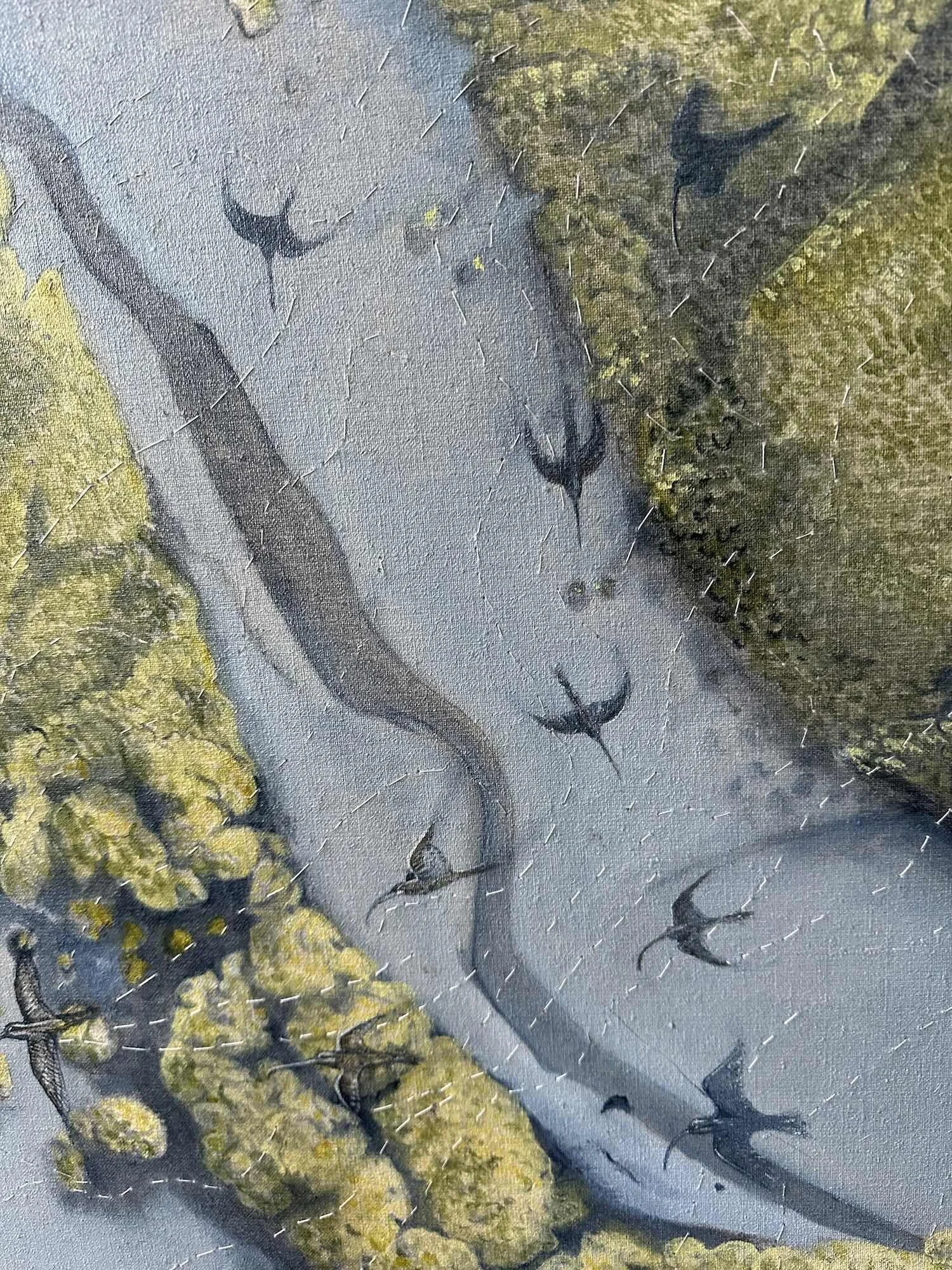
Nostos- detail of stitching
Sanctuary
There's something about Tamborine Mountain.Earlier this month, at Zamia Music Night, our local open mic, we watched people share their talents, their vulnerabilities and their stories. For many, it took enormous courage to step onto a stage and reveal another side of themselves.Each person, in their own way, offered something that helped build community. The audience responded with generosity and warmth, performers held by encouragement rather than judgement. We sang, we danced, we laughed, and for a few hours there was a quiet reminder that community isn't something that simply exists. It is something we continually create.Judith Wright understood this. She found her way to Tamborine Mountain and lived here for more than thirty years, drawing other creative minds, including Charles and Barbara Blackman and Albert Tucker, to what was then a much smaller community. It has long been a sanctuary on the edge of a growing metropolis: a place where the forest announces itself every dawn. Where the air is a little cooler, the views long , a place where you can pause and take a deep breath.Like every place, however, it is changing.Leaf blowers replace birdsong. New fences appear where paddocks and forest once merged into one another. The village evolves as more people discover what has always drawn others here.As someone who has lived on the mountain since 1991, it would be easy to fall into the trap of nostalgia, of believing things were somehow better before. Yet perhaps this change is simply another chapter in the mountain's story. Tamborine continues to attract people seeking inspiration, renewal and belonging. If they leave carrying even a little of that spirit back into the places they call home, then perhaps that too is one of the mountain's gifts.Which leads me to another question.If this mountain gives so much to those who come here, what is our gift in return?Belonging
July and the world is absorbed by the FIFA World Cup, Wimbledon and the Tour de France. We celebrate extraordinary individuals and cheer passionately for teams that represent countries we call our own, or perhaps the countries from which our ancestors came.The world is, after all, a diasporic place.Lately I've found myself thinking about belonging, nationalism, xenophobia and racism. These ideas often sit uneasily beside one another. We celebrate diversity on the sporting field while, elsewhere, people continue to argue over who belongs and who doesn't. We proudly declare our Australian-ness while acknowledging that almost all of us are part of stories of migration.This isn't uniquely Australian.While travelling in the United Kingdom recently I noticed the Flag of St George hanging proudly from lamp posts in a display of Britishness and ‘othering.’ Around the same time I watched an episode of What the British Stole and learnt that the cross itself was originally adopted from the Genoese now part of Italy.History has a wonderful way of reminding us that identity is rarely as fixed as we'd like to believe.Following the Curlews
These are some of the questions that sit beneath my current body of work, Tracing Australia.For the past year I've been travelling, observing and painting in an attempt to better understand what it means to belong to this country. Not ownership, but relationship.The work currently on my easel draws on time spent at Roebuck Bay near Broome in Western Australia.From those vast tidal mudflats it is difficult to comprehend the journeys taking place above your head. Every year Eastern Curlews travel almost 10,000 kilometres from their breeding grounds in Siberia to the wetlands of northern Australia. Before making that extraordinary journey they pause to feed around the Yellow Sea, doubling their body weight before continuing south.Roebuck Bay becomes one of the first places to welcome them.Protected under the Ramsar Convention, these remarkable wetlands support hundreds of thousands of migratory birds every year. For a brief season they belong here. Then they move on.Watching them, I began wondering whether belonging has less to do with permanence than with reciprocity.What do we receive from a place?What do we leave behind?Gardens
Returning home to Tamborine Mountain, I've found myself thinking about belonging through another lens, that of the garden.A garden planted entirely with indigenous species naturally supports the insects, birds and animals that evolved alongside them. Introduce exotic plants and a different ecology begins to emerge. Sometimes that diversity enriches the landscape; sometimes it overwhelms it. Balance matters.Forests teach similar lessons.Ancient trees eventually create openings in the canopy, allowing seedlings to find enough light to grow. Renewal depends upon both continuity and change.Perhaps communities do too.Here I am, a hybrid of many places, living on unceded Wangerriburra Country amongst rainforests and gardens filled with camellias, magnolias, citrus, flame trees and ancient zamias. Outside my window the red cedar has lost its summer canopy and new red leaves are beginning to appear. The king parrots and lorikeets background to this morning.My childhood in Sydney, various travels, and now more than three decades on Tamborine Mountain have all shaped who I am.I can’t rewind the clock to pre-settlement or pre-industrialisation or pre-dot-com or big tech bros. I can be overwhelmed by the rate of change and political hubris, I can suffer solastagia. I can also learn to weed my garden. Perhaps belonging isn't about becoming native.Perhaps it is about learning how to to be a worthy custodian.In the Studio
These thoughts inevitably find their way into the studio.Over the years stitching has slowly become both process and metaphor within my practice.In Chapters, I stitched together archival images, text and handmade paper exploring the life of environmentalist, mountaineer, Buddhist and feminist Marie Byles. In Of Wings and Words, drawings of iconic Australian birds are stitched onto pages from Xavier Herbert's Poor Fellow My Country. In the work now emerging on the easel, stitched lines begin to suggest the unseen magnetic fields that guide the migrations of the Eastern Curlew.Stitching has often been regarded as a feminine act, a quiet language of repair, connection and care.For me it has become a form of meditation.A way of slowing down.A way of tracing relationships.A way of asking, again and again, the same question that began this essay.What does it mean to belong?Perhaps belonging is less about ownership than relationship.Less about where we began than how we care for the places that now hold us.Perhaps that, too, is the mountain's gift.In the Studio This Month…
The work currently on my easel explores migration, magnetic fields and belonging through the annual journey of the Eastern Curlew. Stitching has become both process and metaphor as I continue developing Tracing Australia.